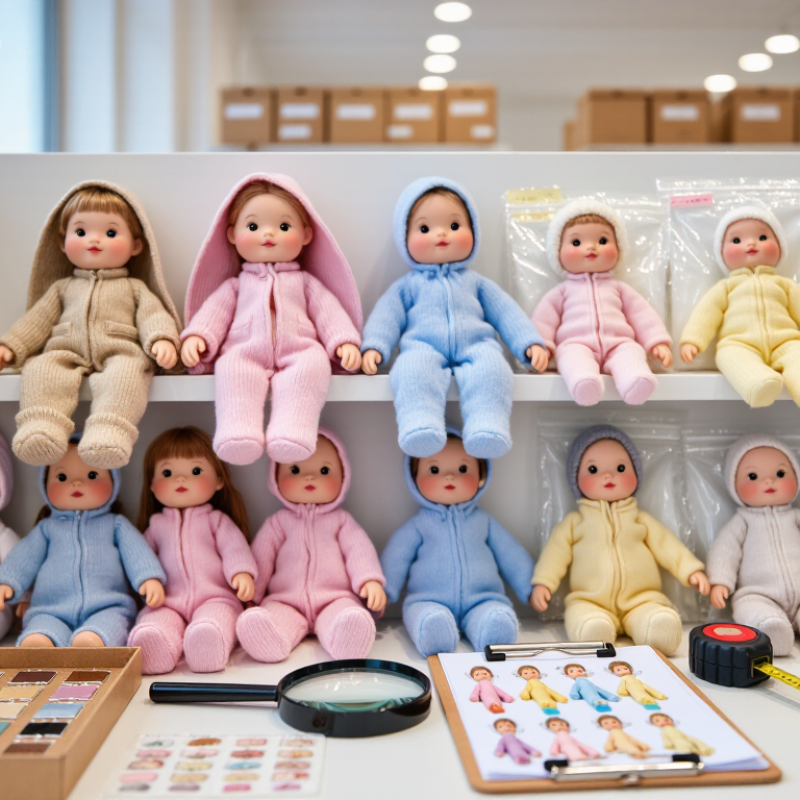
| Product Type | Plush doll, rag doll, character doll, animal doll, or educational soft doll | Select 1 primary construction type and 1–2 size variations | Review product drawings, reference samples, and construction details | A clearly defined product type reduces quotation differences between suppliers. |
| Finished Size | Overall height, width, sitting height, and allowed tolerance | Common retail sizes: 20–35 cm; tolerance: ±5 mm | Measure a pre-production sample with a calibrated ruler or measuring tape | Specify whether the measurement includes ears, hats, tails, or other accessories. |
| Outer Fabric | Fiber content, pile length, color, softness, and surface appearance | Polyester plush or cotton-blend fabric; color variation controlled by approved sample | Check fabric composition, color swatch, pile direction, and surface defects | Longer pile fabrics generally require stricter cutting and brushing controls. |
| Filling Material | Filling type, density, recovery, cleanliness, and distribution | Clean polyester fiber filling with even firmness and no hard lumps | Perform visual inspection, compression recovery check, and weight comparison | Define firmness separately for the head, body, limbs, and decorative parts. |
| Construction | Seam strength, stitch density, attachment method, and shape retention | Uniform seams with no open stitching, loose threads, or visible distortion | Inspect seams inside and outside; conduct pull testing on attached components | High-stress areas such as necks, arms, legs, and ears need additional attention. |
| Safety Classification | Intended age group and whether the item is a toy or a decorative product | Define age marking before quotation; avoid ambiguous “all ages” positioning | Review product design, warnings, small parts, cords, magnets, and detachable components | Age classification affects testing scope, labeling, packaging, and market eligibility. |
| Eyes and Decorative Parts | Embroidered features, plastic eyes, buttons, ribbons, beads, magnets, or other attachments | Use embroidered features for lower-detachment-risk designs where suitable | Check attachment security and perform applicable small-component testing | Every detachable part should be listed in the technical specification and test plan. |
| Color Requirements | Color reference, number of colors, print method, and colorfastness | Approve a physical color standard before mass production | Compare against the approved sample under consistent lighting; check rubbing and wash performance when relevant | Digital screen colors are not sufficient as the only production reference. |
| Customization Level | Stock design, modified design, private-label packaging, or fully custom development | Prepare artwork, dimensions, materials, logo placement, and packaging files in advance | Approve a digital proof and physical sample before production | Full customization usually requires more sampling time and a higher minimum order. |
| Minimum Order Quantity | Minimum units per design, color, size, and packaging configuration | Plan a trial order of approximately 300–1,000 units per design, subject to supplier capability | Request written confirmation of MOQ by SKU and by color | Combining sizes or colors may not reduce MOQ if separate materials or production setups are required. |
| Unit Cost Structure | Product price, sample fee, tooling fee, packaging cost, testing cost, and shipping terms | Request a line-item quotation with currency, Incoterm, validity period, and payment terms | Compare at least three equivalent quotations using the same specification | A lower unit price may exclude packaging, testing, inspection, or freight charges. |
| Sampling | Prototype, revised sample, pre-production sample, and approval procedure | Allow 1–3 sample rounds for a new custom design | Use a signed or documented sample approval checklist | The approved pre-production sample should become the primary quality reference. |
| Production Lead Time | Time from deposit and final approval to finished goods | Typical planning range: 30–60 calendar days after approval for standard-volume orders | Obtain a production schedule with material, sewing, finishing, inspection, and packing milestones | Custom fabric, seasonal demand, testing, and complex packaging can extend the schedule. |
| Packaging | Individual bag, paper card, gift box, carton dimensions, and packing quantity | Define package dimensions and carton gross-weight limit before shipping quotation | Approve a packaging mock-up and verify carton count, weight, and dimensions | Packaging volume can significantly affect freight cost even when product weight is low. |
| Labeling | Age warning, material information, care instructions, country of origin, barcode, and batch code | Prepare market-specific artwork before final sample approval | Check text, symbols, language, placement, durability, and barcode readability | Labeling requirements vary by destination market and product classification. |
| Regulatory Compliance | Applicable toy, chemical, flammability, labeling, and consumer-product requirements | Confirm destination-market requirements before production, not after shipment | Use an accredited laboratory or qualified compliance assessor where required | Testing requirements depend on the destination, intended age, materials, and product design. |
| Restricted Substances | Dyes, coatings, plastic components, adhesives, heavy metals, phthalates, and other regulated substances | Use documented material declarations and test reports appropriate to the destination market | Review supplier declarations and conduct risk-based laboratory testing | A previous report may not cover a new fabric, color, component, or production facility. |
| Quality Standard | Acceptable quality limits for critical, major, and minor defects | Set a written inspection standard before mass production; use an agreed sampling plan | Conduct pre-production, in-process, and pre-shipment inspections | Define critical defects as unacceptable and document measurable limits for other defects. |
| Order Quantity Forecast | Initial purchase quantity, monthly demand, seasonal peaks, and reorder frequency | Prepare a 6–12 month forecast with a safety-stock assumption | Compare forecast demand with MOQ, production capacity, shelf life, and storage space | A realistic forecast improves negotiation on price, capacity reservation, and replenishment time. |
| Logistics | Shipping method, destination, carton data, delivery deadline, and import responsibilities | Calculate landed cost using confirmed carton dimensions and gross weight | Request freight quotations based on the final packing specification | Choose the shipping method according to delivery urgency, order value, and inventory plan. |
| Supplier Evaluation | Relevant experience, sample quality, communication, production capacity, and documentation | Shortlist suppliers that can provide samples, specifications, and compliance evidence | Use a weighted scorecard covering quality, cost, lead time, capacity, and risk | Evaluate the production site and subcontracting arrangements when order risk is significant. |